Growing website traffic is one of the biggest challenges for bloggers, businesses, and digital marketers. Whether you run a blog, an ecommerce store, or a company website, more traffic often means more leads, sales, and brand visibility.
However, increasing traffic in 2026 requires more than publishing random blog posts or sharing links on social media. Modern search engines now rely heavily on user intent, content quality, technical performance, and authority signals to determine which websites deserve visibility.
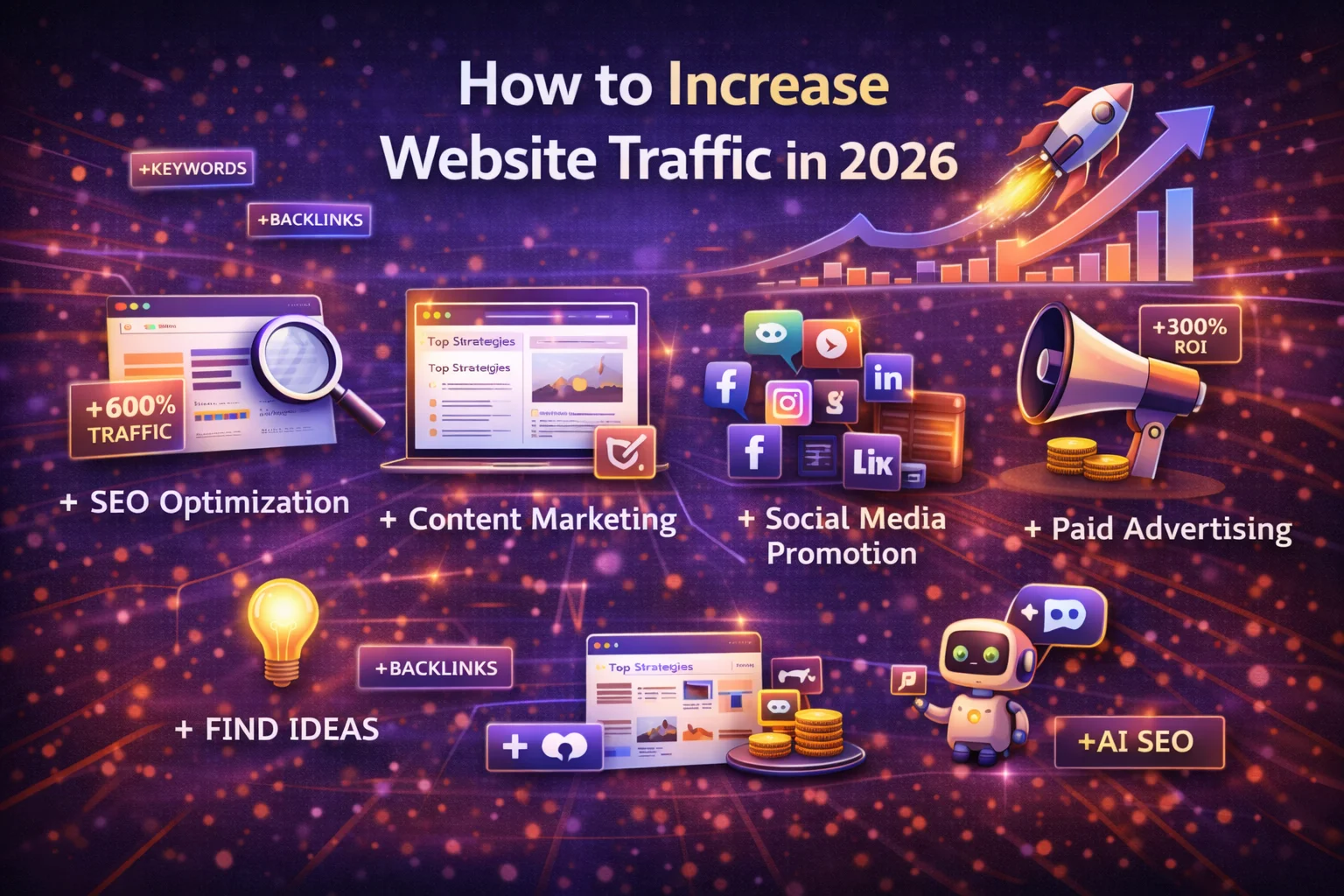
This guide explains proven strategies to increase website traffic in 2026, covering SEO, content marketing, social media, and technical optimization techniques that work in today’s search environment.
Why Website Traffic Matters
Website traffic refers to the number of visitors who access your website. While traffic alone does not guarantee conversions, attracting the right audience can significantly improve your business results.
Increasing website traffic helps you:
- grow brand awareness
- generate leads and customers
- improve search engine rankings
- build authority in your niche
More importantly, organic traffic from search engines can generate long-term results without continuous advertising costs.
Strategy 1: Focus on SEO First
Search engine optimization (SEO) remains the most powerful method for driving consistent website traffic.
SEO helps websites rank in search engines like Google for relevant queries. The higher your pages appear in search results, the more likely users are to visit your site.
Modern SEO strategies focus on:
- keyword research
- content quality
- backlinks
- technical performance
Search engines evaluate hundreds of signals to determine rankings, including content relevance, page speed, and mobile usability.
Websites that follow SEO best practices typically experience steady traffic growth over time.
Strategy 2: Perform Keyword Research
Keyword research is the foundation of successful SEO.
Keywords represent the phrases users type into search engines. Identifying the right keywords allows you to create content that matches real search demand.
For example:
| Keyword | Search Intent |
|---|---|
| best website builder | comparison |
| how to start a blog | tutorial |
| keyword research tools | informational |
SEO experts emphasize that keyword research should be the first step when trying to grow organic traffic because keywords guide your entire content strategy.
Tips for finding profitable keywords
- target long-tail keywords
- analyze competitor keywords
- focus on low-competition topics
- understand search intent
Long-tail keywords often provide better opportunities for smaller websites because competition is lower.
Strategy 3: Create High-Quality Content
Content remains the most important factor for attracting organic traffic.
Search engines prioritize content that provides useful and comprehensive answers to user queries.
Effective content should:
- solve a real problem
- provide clear explanations
- include examples and visuals
- answer common questions
Search algorithms increasingly evaluate context and meaning rather than simple keyword usage, meaning content must be helpful and relevant rather than keyword-stuffed.
Publishing valuable content consistently builds authority and encourages visitors to return.
Strategy 4: Build Topic Clusters and Pillar Content
One of the most effective SEO strategies today is building topic clusters.
Instead of publishing isolated articles, create a central “pillar” page supported by multiple related articles.
Example structure:
Pillar topic
- Complete SEO Guide
Supporting articles
- Keyword research guide
- On-page SEO checklist
- Technical SEO guide
- Backlink strategies
Search engines increasingly reward websites that cover topics comprehensively because it demonstrates expertise and authority.
Topic clusters also improve internal linking and user navigation.
Strategy 5: Improve On-Page SEO
On-page SEO refers to optimizing elements within individual pages.
Important on-page factors include:
- title tags
- meta descriptions
- headings (H1, H2, H3)
- internal links
- image optimization
Optimizing these elements helps search engines understand your content and improves the user experience.
SEO best practices also recommend using descriptive titles, structured headings, and clear navigation to make content easier to read.
Strategy 6: Build High-Quality Backlinks
Backlinks remain one of the strongest ranking signals.
A backlink occurs when another website links to your content. These links act as “votes of confidence” that signal trust and authority to search engines.
Effective link-building strategies include:
- guest blogging
- digital PR
- creating shareable content
- publishing research studies
Modern SEO focuses more on quality backlinks rather than quantity, as authoritative links provide stronger ranking signals.
Strategy 7: Optimize Website Speed and User Experience
Website performance plays a major role in both rankings and user engagement.
Search engines consider page speed and user experience when ranking websites.
Important performance factors include:
- fast loading times
- mobile responsiveness
- stable page layout
- easy navigation
Core Web Vitals metrics such as loading speed and visual stability continue to be important ranking signals in modern SEO.
Websites that load quickly and provide smooth user experiences tend to retain visitors longer.
Strategy 8: Use Social Media to Amplify Content
Social media platforms can significantly increase website traffic when used strategically.
Instead of simply sharing links, successful marketers share engaging content that encourages users to click and learn more.
Effective social media strategies include:
- sharing valuable insights from blog posts
- posting engaging visuals
- interacting with your audience
Active social media profiles also improve brand visibility and can drive new visitors to your website.
Strategy 9: Update and Refresh Old Content
Many websites overlook one of the easiest ways to increase traffic: updating existing content.
Search engines favor fresh and accurate information. Updating older articles with new data, examples, and insights can improve rankings.
Content updates may include:
- adding new sections
- improving readability
- updating statistics
- fixing outdated information
Refreshing content also signals to search engines that your website remains relevant and active.
Strategy 10: Optimize for AI-Driven Search
Search behavior is changing rapidly as AI-powered search engines and generative answers become more common.
Nearly half of users now interact with AI-driven search systems, which means content must be structured clearly so AI tools can interpret it.
To optimize for AI search:
- write clear explanations
- structure content with headings
- answer questions directly
- include factual information
This approach improves visibility in both traditional search results and AI-generated responses.
Strategy 11: Use Internal Linking
Internal linking helps search engines discover pages and understand relationships between topics.
A strong internal linking structure can:
- distribute authority across pages
- improve user navigation
- increase time on site
For example, linking related guides and tutorials encourages visitors to explore more content.
Strategy 12: Monitor Traffic and SEO Performance
Growing traffic requires ongoing analysis and improvement.
Tracking tools can help you understand:
- which pages generate traffic
- which keywords drive visitors
- where visitors come from
Data analysis allows you to refine your strategy and focus on the most effective traffic sources.
Common Website Traffic Mistakes
Many websites struggle to grow traffic because of these mistakes:
Publishing Content Without Keyword Research
Without understanding search demand, content may fail to attract visitors.
Ignoring Search Intent
Content must match what users expect to find.
Low-Quality Content
Search engines prioritize helpful and authoritative information.
Poor Website Performance
Slow loading speeds and poor mobile design can reduce rankings.
Avoiding these mistakes is essential for long-term growth.
Website Traffic Trends in 2026
The digital marketing landscape continues evolving rapidly.
Several trends are shaping website traffic strategies today:
AI-Driven Search
Search engines increasingly use AI to interpret user queries and provide direct answers.
Topical Authority
Websites that publish multiple related articles on a topic tend to rank higher.
User Experience Signals
Engagement metrics such as time on page and interaction rates influence search visibility.
Multi-Channel Traffic
Traffic no longer comes only from search engines. Social media, AI platforms, and referral links also play a growing role.
Final Thoughts
Increasing website traffic in 2026 requires a strategic and consistent approach. The most successful websites combine SEO, high-quality content, technical optimization, and audience engagement to build sustainable traffic growth.
Rather than focusing on quick tactics, the key is to create valuable content, optimize your website for search engines, and continuously improve your strategy based on data.
By implementing the proven strategies in this guide—keyword research, content creation, backlink building, and performance optimization—you can build a strong foundation for long-term website growth and attract a steady stream of visitors to your site.
FAQ’s
1. How can beginners increase website traffic?
Beginners can increase website traffic by focusing on SEO, performing keyword research, creating helpful content, building backlinks, and promoting content through social media and email marketing.
2. What is the fastest way to increase website traffic?
The fastest ways to increase website traffic include publishing high-quality SEO content, targeting low-competition keywords, sharing content on social media, and building backlinks from relevant websites.
3. Does SEO help increase website traffic?
Yes, SEO is one of the most effective ways to increase website traffic because it helps websites rank higher in search engine results, bringing consistent organic visitors.
4. How long does it take to increase website traffic with SEO?
SEO typically takes 3 to 6 months to show noticeable traffic growth, depending on keyword competition, website authority, and content quality.
5. What are the best strategies to increase organic traffic in 2026?
The best strategies include keyword research, creating high-quality content, building topical authority, improving technical SEO, earning backlinks, and optimizing for AI-driven search results.