How to Analyze Competitors for SEO (Complete Beginner Guide)

Understanding what your competitors are doing in search engines is one of the fastest ways to improve your own SEO strategy. Instead of guessing which keywords to target or what content to create, competitor analysis allows you to learn from websites that are already ranking well in your niche.

SEO competitor analysis involves researching other websites that appear in search results for the same keywords you want to rank for. By studying their content, backlinks, and strategies, you can discover opportunities to improve your own website and attract more organic traffic.

In this complete beginner guide, you’ll learn how to analyze competitors for SEO in 2026, including the tools, strategies, and steps professionals use to identify ranking opportunities and outperform competing websites.


What Is SEO Competitor Analysis?

SEO competitor analysis is the process of evaluating websites that rank for your target keywords in search engines.

The goal is to understand:

  • what keywords competitors rank for
  • which pages drive their traffic
  • where their backlinks come from
  • how their content is structured

By analyzing these factors, you can identify gaps in your strategy and find ways to create better content.

Competitor analysis also helps you understand the competitive landscape of your niche and determine how difficult it will be to rank for certain keywords.


Why Competitor Analysis Is Important for SEO

SEO competitor analysis plays a crucial role in modern search optimization strategies.

Here are some of the main benefits.

Discover Profitable Keywords

Your competitors are already ranking for keywords that generate traffic. By identifying these keywords, you can target them in your own content.

Understand Content Strategies

Competitor analysis reveals the type of content that performs well in your niche.

You can see which topics attract the most traffic and which formats work best.

Identify Backlink Opportunities

Backlinks remain one of the most important ranking factors. Studying competitor backlinks helps you find websites that may also link to your content.

Improve Your SEO Strategy

By comparing your website with competitors, you can identify areas where your site needs improvement.


Identify Your Real SEO Competitors

Many beginners assume their competitors are businesses selling similar products or services.

However, in SEO, your real competitors are the websites that rank for the same keywords you want to target.

For example, if you search for a keyword like “keyword research tools,” the top results might include:

  • blogs
  • software companies
  • SEO tutorials

These websites become your SEO competitors because they compete for the same search traffic.

How to find competitors

  1. Search your main keyword on Google
  2. Analyze the websites appearing on the first page
  3. Identify websites consistently ranking for multiple related keywords

These sites are your main SEO competitors.


Analyze Competitor Keywords

Keyword analysis is one of the most important parts of competitor research.

Your competitors may already rank for hundreds or thousands of keywords.

Studying these keywords helps you discover:

  • new content ideas
  • high-traffic topics
  • long-tail keyword opportunities

How to analyze competitor keywords

  1. Identify competitor websites
  2. examine the keywords they rank for
  3. find keywords with moderate competition and strong search demand

Focus particularly on keywords where competitors receive significant traffic.

These keywords often represent the best opportunities for growth.


Evaluate Competitor Content

High-quality content plays a major role in search rankings.

Analyzing competitor content helps you understand what type of information search engines prefer for specific keywords.

When reviewing competitor pages, consider the following factors.

Content Length

Many high-ranking pages provide comprehensive coverage of a topic.

Long-form content often performs better because it answers more questions and provides deeper insights.

Content Structure

Well-structured content usually includes:

  • clear headings
  • bullet points
  • images and examples
  • internal links

This structure improves readability and user experience.

Search Intent Alignment

Successful pages match the intent behind the search query.

For example:

  • informational keywords require educational guides
  • comparison keywords require product comparisons
  • transactional keywords require product pages

Understanding search intent helps you create content that satisfies user expectations.


Analyze Competitor Backlinks

Backlinks remain one of the strongest ranking signals in search engine algorithms.

Competitor backlink analysis helps you identify websites that link to similar content.

These websites may also be willing to link to your pages.

Steps to analyze backlinks

  1. identify competitor websites
  2. review their backlink profiles
  3. find authoritative websites linking to them

Common backlink sources include:

  • guest articles
  • blog mentions
  • industry directories
  • research citations

Building relationships with these sources can help strengthen your own backlink profile.


Study Competitor Website Structure

Website structure plays an important role in SEO.

A well-organized site helps search engines understand how pages relate to each other.

Analyze competitor websites to see how they structure their content.

Look for patterns such as:

  • topic clusters
  • pillar pages
  • internal linking strategies

For example, many successful websites use a pillar and cluster model, where a main guide links to several supporting articles.

This structure improves both user navigation and search engine understanding.


Examine Technical SEO Performance

Technical factors can also influence search rankings.

When analyzing competitors, review aspects such as:

  • page loading speed
  • mobile responsiveness
  • URL structure
  • internal linking

Fast and well-optimized websites typically provide better user experiences and may perform better in search results.

Tools that analyze website performance can reveal technical strengths and weaknesses in competitor sites.


Identify Content Gaps

Content gaps are topics your competitors have not fully covered.

Finding these gaps allows you to create content that addresses unanswered questions or provides deeper insights.

How to find content gaps

  • compare competitor content topics
  • analyze missing subtopics
  • identify questions users ask but competitors have not answered

Publishing content that fills these gaps can help your website stand out in search results.


Analyze Top Performing Pages

Another effective strategy is identifying competitor pages that generate the most traffic.

These pages often reveal:

  • high-demand topics
  • successful content formats
  • valuable keyword opportunities

For example, if a competitor’s guide attracts significant traffic, you can create a more detailed and updated version of the same topic.

This approach is often called the “skyscraper technique” in SEO.


Tools for SEO Competitor Analysis

Many tools can help simplify competitor research.

These tools allow you to analyze:

  • keyword rankings
  • traffic estimates
  • backlink profiles
  • technical performance

Common SEO analysis tools provide data that would otherwise be difficult to collect manually.

Using these tools helps marketers make data-driven decisions when planning their content strategies.


Create a Competitor Analysis Workflow

To make competitor analysis easier, follow a structured workflow.

Step 1 – Identify your main competitors

Search your target keywords and list the websites appearing frequently in results.

Step 2 – Analyze competitor keywords

Identify high-traffic keywords driving traffic to competitor pages.

Step 3 – Review competitor content

Evaluate the depth, structure, and quality of their content.

Step 4 – Study backlinks

Look for opportunities to earn links from similar sources.

Step 5 – Identify gaps

Create content that improves on existing competitor pages.

Following this process ensures that competitor analysis becomes a consistent part of your SEO strategy.


Common Mistakes in Competitor Analysis

Beginners sometimes make mistakes when studying competitors.

Copying Competitor Content

Instead of copying, focus on improving and expanding existing ideas.

Ignoring Search Intent

Content must match what users expect from the search query.

Targeting Extremely Competitive Keywords

Highly competitive keywords may be difficult for new websites to rank for.

Focus on achievable opportunities first.

Overlooking Content Quality

Search engines reward content that provides genuine value to readers.


SEO Competitor Analysis Trends in 2026

SEO continues evolving as search engines become more advanced.

Several trends influence competitor analysis today.

AI-Powered Search

Search engines increasingly use AI to interpret content and deliver direct answers.

Topical Authority

Websites that cover topics comprehensively often rank better.

User Experience Signals

Search engines evaluate engagement metrics such as time on page and bounce rates.

Data-Driven SEO

Modern SEO strategies rely heavily on data analysis rather than guesswork.


Final Thoughts

Competitor analysis is one of the most powerful tools in SEO. By studying the strategies of websites that already rank well, beginners can gain valuable insights into what works in their niche.

Instead of starting from scratch, competitor research allows you to identify successful keywords, understand content trends, and uncover opportunities to create better resources.

In 2026, effective SEO requires more than publishing random content. It requires strategic planning, continuous analysis, and a deep understanding of both search engines and user intent.

By following the techniques in this guide, you can develop a strong SEO strategy that leverages competitor insights to grow your website’s visibility and attract sustainable organic traffic.

FAQ’s

1. What is SEO competitor analysis?

SEO competitor analysis is the process of studying websites that rank for your target keywords to understand their content, backlinks, keywords, and strategies so you can improve your own SEO performance.


2. Why is competitor analysis important for SEO?

Competitor analysis helps identify profitable keywords, understand successful content strategies, and discover backlink opportunities that can improve your search rankings and organic traffic.


3. How do beginners analyze SEO competitors?

Beginners can analyze competitors by searching their target keywords on Google, identifying top-ranking websites, studying their content and keywords, analyzing their backlinks, and finding gaps to create better content.


4. What tools are used for SEO competitor analysis?

Common tools used for SEO competitor analysis include keyword research platforms, backlink analysis tools, traffic analysis tools, and website audit tools that help analyze rankings, backlinks, and content strategies.


5. What is the easiest way to beat competitors in SEO?

The easiest way to outperform competitors is to create higher-quality content, target long-tail keywords, improve website performance, and build strong backlinks from authoritative websites.

How to Increase Website Traffic in 2026 (Proven Strategies)

Growing website traffic is one of the biggest challenges for bloggers, businesses, and digital marketers. Whether you run a blog, an ecommerce store, or a company website, more traffic often means more leads, sales, and brand visibility.

However, increasing traffic in 2026 requires more than publishing random blog posts or sharing links on social media. Modern search engines now rely heavily on user intent, content quality, technical performance, and authority signals to determine which websites deserve visibility.

This guide explains proven strategies to increase website traffic in 2026, covering SEO, content marketing, social media, and technical optimization techniques that work in today’s search environment.


Why Website Traffic Matters

Website traffic refers to the number of visitors who access your website. While traffic alone does not guarantee conversions, attracting the right audience can significantly improve your business results.

Increasing website traffic helps you:

  • grow brand awareness
  • generate leads and customers
  • improve search engine rankings
  • build authority in your niche

More importantly, organic traffic from search engines can generate long-term results without continuous advertising costs.


Strategy 1: Focus on SEO First

Search engine optimization (SEO) remains the most powerful method for driving consistent website traffic.

SEO helps websites rank in search engines like Google for relevant queries. The higher your pages appear in search results, the more likely users are to visit your site.

Modern SEO strategies focus on:

  • keyword research
  • content quality
  • backlinks
  • technical performance

Search engines evaluate hundreds of signals to determine rankings, including content relevance, page speed, and mobile usability.

Websites that follow SEO best practices typically experience steady traffic growth over time.


Strategy 2: Perform Keyword Research

Keyword research is the foundation of successful SEO.

Keywords represent the phrases users type into search engines. Identifying the right keywords allows you to create content that matches real search demand.

For example:

KeywordSearch Intent
best website buildercomparison
how to start a blogtutorial
keyword research toolsinformational

SEO experts emphasize that keyword research should be the first step when trying to grow organic traffic because keywords guide your entire content strategy.

Tips for finding profitable keywords

  • target long-tail keywords
  • analyze competitor keywords
  • focus on low-competition topics
  • understand search intent

Long-tail keywords often provide better opportunities for smaller websites because competition is lower.


Strategy 3: Create High-Quality Content

Content remains the most important factor for attracting organic traffic.

Search engines prioritize content that provides useful and comprehensive answers to user queries.

Effective content should:

  • solve a real problem
  • provide clear explanations
  • include examples and visuals
  • answer common questions

Search algorithms increasingly evaluate context and meaning rather than simple keyword usage, meaning content must be helpful and relevant rather than keyword-stuffed.

Publishing valuable content consistently builds authority and encourages visitors to return.


Strategy 4: Build Topic Clusters and Pillar Content

One of the most effective SEO strategies today is building topic clusters.

Instead of publishing isolated articles, create a central “pillar” page supported by multiple related articles.

Example structure:

Pillar topic

  • Complete SEO Guide

Supporting articles

  • Keyword research guide
  • On-page SEO checklist
  • Technical SEO guide
  • Backlink strategies

Search engines increasingly reward websites that cover topics comprehensively because it demonstrates expertise and authority.

Topic clusters also improve internal linking and user navigation.


Strategy 5: Improve On-Page SEO

On-page SEO refers to optimizing elements within individual pages.

Important on-page factors include:

  • title tags
  • meta descriptions
  • headings (H1, H2, H3)
  • internal links
  • image optimization

Optimizing these elements helps search engines understand your content and improves the user experience.

SEO best practices also recommend using descriptive titles, structured headings, and clear navigation to make content easier to read.


Strategy 6: Build High-Quality Backlinks

Backlinks remain one of the strongest ranking signals.

A backlink occurs when another website links to your content. These links act as “votes of confidence” that signal trust and authority to search engines.

Effective link-building strategies include:

  • guest blogging
  • digital PR
  • creating shareable content
  • publishing research studies

Modern SEO focuses more on quality backlinks rather than quantity, as authoritative links provide stronger ranking signals.


Strategy 7: Optimize Website Speed and User Experience

Website performance plays a major role in both rankings and user engagement.

Search engines consider page speed and user experience when ranking websites.

Important performance factors include:

  • fast loading times
  • mobile responsiveness
  • stable page layout
  • easy navigation

Core Web Vitals metrics such as loading speed and visual stability continue to be important ranking signals in modern SEO.

Websites that load quickly and provide smooth user experiences tend to retain visitors longer.


Strategy 8: Use Social Media to Amplify Content

Social media platforms can significantly increase website traffic when used strategically.

Instead of simply sharing links, successful marketers share engaging content that encourages users to click and learn more.

Effective social media strategies include:

  • sharing valuable insights from blog posts
  • posting engaging visuals
  • interacting with your audience

Active social media profiles also improve brand visibility and can drive new visitors to your website.


Strategy 9: Update and Refresh Old Content

Many websites overlook one of the easiest ways to increase traffic: updating existing content.

Search engines favor fresh and accurate information. Updating older articles with new data, examples, and insights can improve rankings.

Content updates may include:

  • adding new sections
  • improving readability
  • updating statistics
  • fixing outdated information

Refreshing content also signals to search engines that your website remains relevant and active.


Strategy 10: Optimize for AI-Driven Search

Search behavior is changing rapidly as AI-powered search engines and generative answers become more common.

Nearly half of users now interact with AI-driven search systems, which means content must be structured clearly so AI tools can interpret it.

To optimize for AI search:

  • write clear explanations
  • structure content with headings
  • answer questions directly
  • include factual information

This approach improves visibility in both traditional search results and AI-generated responses.


Strategy 11: Use Internal Linking

Internal linking helps search engines discover pages and understand relationships between topics.

A strong internal linking structure can:

  • distribute authority across pages
  • improve user navigation
  • increase time on site

For example, linking related guides and tutorials encourages visitors to explore more content.


Strategy 12: Monitor Traffic and SEO Performance

Growing traffic requires ongoing analysis and improvement.

Tracking tools can help you understand:

  • which pages generate traffic
  • which keywords drive visitors
  • where visitors come from

Data analysis allows you to refine your strategy and focus on the most effective traffic sources.


Common Website Traffic Mistakes

Many websites struggle to grow traffic because of these mistakes:

Publishing Content Without Keyword Research

Without understanding search demand, content may fail to attract visitors.

Ignoring Search Intent

Content must match what users expect to find.

Low-Quality Content

Search engines prioritize helpful and authoritative information.

Poor Website Performance

Slow loading speeds and poor mobile design can reduce rankings.

Avoiding these mistakes is essential for long-term growth.


Website Traffic Trends in 2026

The digital marketing landscape continues evolving rapidly.

Several trends are shaping website traffic strategies today:

AI-Driven Search

Search engines increasingly use AI to interpret user queries and provide direct answers.

Topical Authority

Websites that publish multiple related articles on a topic tend to rank higher.

User Experience Signals

Engagement metrics such as time on page and interaction rates influence search visibility.

Multi-Channel Traffic

Traffic no longer comes only from search engines. Social media, AI platforms, and referral links also play a growing role.


Final Thoughts

Increasing website traffic in 2026 requires a strategic and consistent approach. The most successful websites combine SEO, high-quality content, technical optimization, and audience engagement to build sustainable traffic growth.

Rather than focusing on quick tactics, the key is to create valuable content, optimize your website for search engines, and continuously improve your strategy based on data.

By implementing the proven strategies in this guide—keyword research, content creation, backlink building, and performance optimization—you can build a strong foundation for long-term website growth and attract a steady stream of visitors to your site.

FAQ’s

1. How can beginners increase website traffic?

Beginners can increase website traffic by focusing on SEO, performing keyword research, creating helpful content, building backlinks, and promoting content through social media and email marketing.


2. What is the fastest way to increase website traffic?

The fastest ways to increase website traffic include publishing high-quality SEO content, targeting low-competition keywords, sharing content on social media, and building backlinks from relevant websites.


3. Does SEO help increase website traffic?

Yes, SEO is one of the most effective ways to increase website traffic because it helps websites rank higher in search engine results, bringing consistent organic visitors.


4. How long does it take to increase website traffic with SEO?

SEO typically takes 3 to 6 months to show noticeable traffic growth, depending on keyword competition, website authority, and content quality.


5. What are the best strategies to increase organic traffic in 2026?

The best strategies include keyword research, creating high-quality content, building topical authority, improving technical SEO, earning backlinks, and optimizing for AI-driven search results.

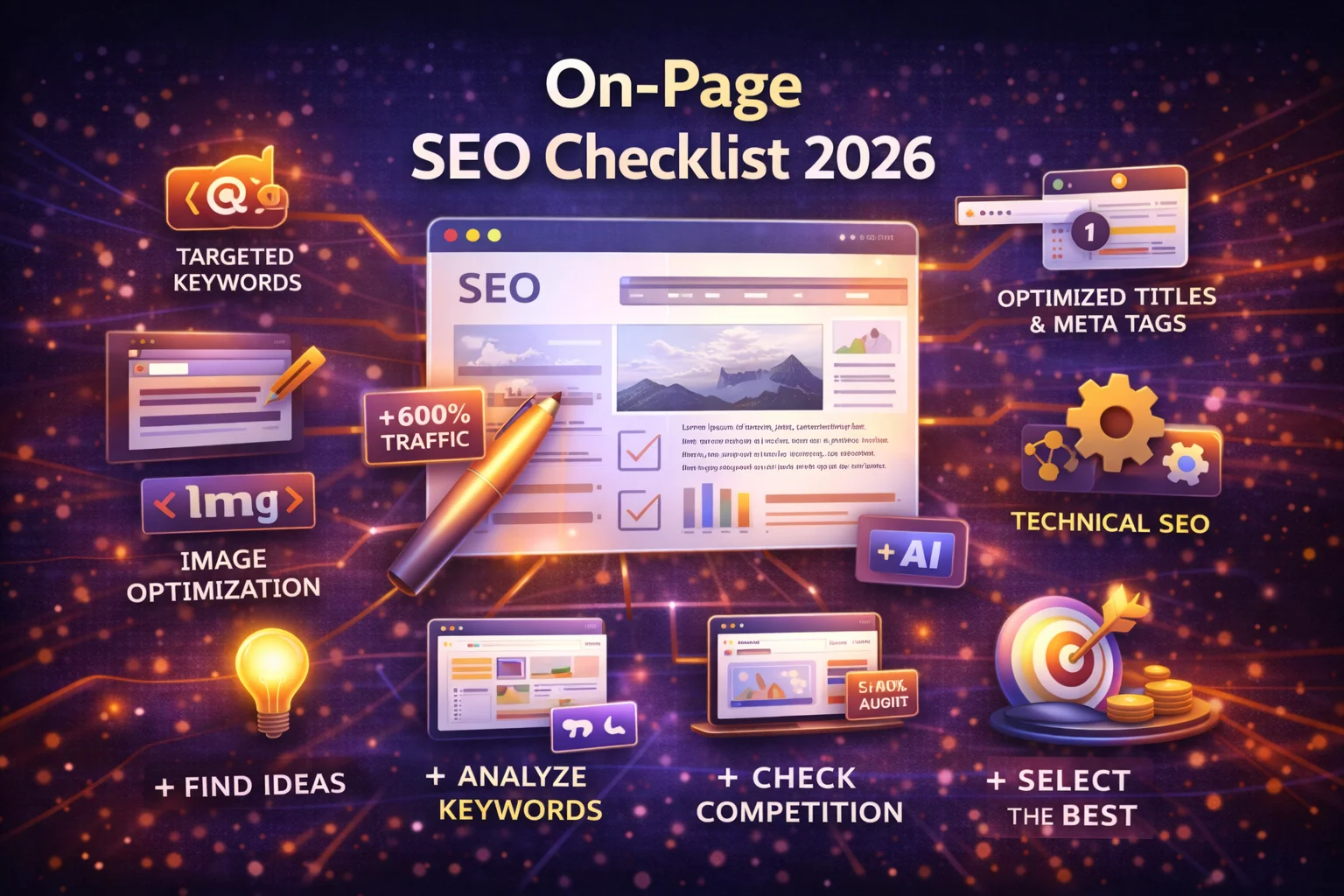
On-Page SEO Checklist 2026: How to Optimize Your Website Step by Step

On-page SEO is one of the most important aspects of search engine optimization. While backlinks and technical factors also influence rankings, optimizing the content and structure of individual pages is often the first step toward improving search visibility.

In simple terms, on-page SEO refers to the practice of optimizing elements within a web page to improve its ranking in search engine results and provide a better user experience. These elements include content quality, keyword placement, headings, internal links, page speed, and more.

For beginners, understanding and implementing on-page SEO can dramatically increase the chances of ranking higher on search engines like Google. This guide provides a complete on-page SEO checklist for 2026, covering the most important factors that help websites rank in modern search results.


What Is On-Page SEO?

On-page SEO involves optimizing the content and HTML elements of a page so that search engines can understand it and rank it appropriately. Unlike off-page SEO, which focuses on backlinks and external signals, on-page SEO is entirely under your control.

Examples of on-page SEO factors include:

  • keyword optimization
  • title tags and meta descriptions
  • internal linking
  • content quality
  • page structure
  • mobile usability

Search engines analyze these elements to determine whether a page provides relevant and valuable information for users.


Why On-Page SEO Matters in 2026

Search engines have evolved significantly in recent years. Modern algorithms use artificial intelligence and advanced natural language processing to evaluate content quality and relevance.

Despite these advancements, on-page SEO remains essential because it helps search engines interpret your content and understand its context.

Key benefits of on-page SEO

  • Improves search engine rankings
  • Helps search engines understand page content
  • Enhances user experience
  • Increases organic traffic
  • Improves click-through rates

When implemented correctly, on-page optimization ensures that your website communicates clearly with both users and search engines.


The Complete On-Page SEO Checklist

Below is a step-by-step checklist beginners can follow to optimize their pages effectively.


1. Perform Keyword Research First

Every successful SEO strategy starts with keyword research. Before creating content, you must identify the keywords people search for related to your topic.

Keyword research helps you discover:

  • search demand
  • keyword difficulty
  • user intent

Focus on keywords that have:

  • moderate search volume
  • lower competition
  • clear search intent

Long-tail keywords are particularly valuable for beginners because they are easier to rank for.

Example:

Instead of targeting:

SEO tools

Target:

best SEO tools for beginners


2. Optimize the Title Tag

The title tag is one of the most important on-page SEO elements.

It tells search engines and users what your page is about and appears as the clickable headline in search results.

Best practices for title tags

  • include your primary keyword
  • keep it under 60 characters
  • make it engaging for users

Example:

Complete On-Page SEO Checklist for Beginners (2026 Guide)

A well-optimized title tag can significantly improve click-through rates.


3. Write a Compelling Meta Description

Meta descriptions summarize your page content and appear below the title in search results.

Although meta descriptions are not a direct ranking factor, they strongly influence click-through rates.

Best practices

  • keep length around 150–160 characters
  • include your main keyword
  • highlight the value of the content

Example:

“Learn the complete on-page SEO checklist for beginners in 2026. Optimize titles, content, internal links, and technical factors to rank higher in Google.”


4. Use Proper Heading Structure

Headings organize your content and make it easier for both readers and search engines to understand.

Use headings in a logical hierarchy.

Example:

  • H1 – main title
  • H2 – main sections
  • H3 – subtopics

A clear structure improves readability and helps search engines identify important topics within your content.


5. Optimize Content for Search Intent

Search intent refers to the reason behind a user’s search query.

Search engines prioritize pages that satisfy the user’s intent.

There are four main types of search intent:

Intent TypeExample
Informationalwhat is SEO
NavigationalYouTube login
Commercialbest SEO tools
Transactionalbuy website builder

Before writing content, analyze the top search results for your keyword to understand what users expect.


6. Write High-Quality Content

Content quality remains one of the most important ranking factors.

Your content should be:

  • helpful
  • accurate
  • well-structured
  • comprehensive

Modern search algorithms prioritize content that demonstrates expertise and provides clear value.

High-quality content also increases engagement and reduces bounce rates.


7. Use Internal Links

Internal links connect pages within your website.

They help search engines discover content and distribute authority across your site.

Example internal links:

  • linking related blog posts
  • linking product pages from guides
  • linking tutorials from category pages

Internal linking also improves user navigation and encourages visitors to explore more content.


8. Optimize Images

Images play an important role in both user experience and SEO.

However, large images can slow down page speed.

Image optimization tips

  • compress images to reduce file size
  • use descriptive file names
  • add alt text

Alt text helps search engines understand what the image represents and improves accessibility.


9. Improve Page Loading Speed

Page speed is a ranking factor because slow websites create poor user experiences.

Users expect websites to load quickly, especially on mobile devices.

Ways to improve page speed include:

  • compressing images
  • using fast hosting
  • minimizing scripts
  • enabling caching

Faster websites generally achieve better engagement and rankings.


10. Ensure Mobile-Friendly Design

Most internet users now access websites on mobile devices.

Search engines prioritize mobile-friendly websites in search results.

Your pages should:

  • adapt to smaller screens
  • use readable fonts
  • provide easy navigation

Responsive design ensures your content looks good on all devices.


11. Use SEO-Friendly URLs

URLs should be simple, descriptive, and include relevant keywords.

Example:

Bad URL:

example.com/page?id=123

Good URL:

example.com/on-page-seo-checklist

Clean URLs improve readability and help search engines understand page topics.


12. Add Schema Markup

Schema markup helps search engines understand the structure of your content.

It can also improve visibility in search results by enabling rich snippets.

Examples include:

  • FAQ schema
  • article schema
  • product schema

Structured data enhances how your pages appear in search results.


13. Optimize for Featured Snippets

Featured snippets appear at the top of search results and provide quick answers to user queries.

To increase your chances of appearing in snippets:

  • answer questions clearly
  • use lists and tables
  • provide concise explanations

Content structured this way is easier for search engines to extract.


14. Monitor SEO Performance

SEO is an ongoing process.

Track your results using analytics and search console tools to understand:

  • keyword rankings
  • organic traffic
  • click-through rates

Regular monitoring helps identify opportunities for improvement.


Common On-Page SEO Mistakes

Many beginners make mistakes that limit their SEO performance.

Keyword stuffing

Using keywords excessively can harm readability and rankings.

Ignoring search intent

Content must align with user expectations.

Poor internal linking

Internal links help distribute authority and improve navigation.

Low-quality content

Thin or poorly written content rarely ranks well.

Avoiding these mistakes is essential for long-term SEO success.


On-Page SEO Trends in 2026

SEO continues evolving as search engines become more sophisticated.

Several trends are shaping modern on-page optimization.

AI-powered search

Search engines use AI to interpret content and understand context more accurately.

Topical authority

Websites that cover topics deeply across multiple pages perform better in search results.

E-E-A-T signals

Google evaluates content based on experience, expertise, authoritativeness, and trustworthiness.

User experience signals

Engagement metrics such as time on page and bounce rate influence rankings.


Final Thoughts

On-page SEO is the foundation of any successful SEO strategy. By optimizing your content, page structure, and technical elements, you help search engines understand your website and improve your chances of ranking higher in search results.

For beginners, the most important steps include conducting keyword research, writing high-quality content, optimizing titles and headings, improving page speed, and ensuring mobile usability.

As search engines continue evolving in 2026, focusing on user intent, content quality, and technical optimization will remain essential for long-term SEO success.

By following this on-page SEO checklist consistently, you can build a strong foundation that helps your website grow its visibility and attract sustainable organic traffic.

FAQ’s

1. What is on-page SEO?

On-page SEO refers to optimizing elements within a web page—such as content, title tags, headings, internal links, and images—to improve its ranking in search engine results.


2. Why is on-page SEO important for ranking on Google?

On-page SEO helps search engines understand your content and determine its relevance to user queries. Proper optimization improves visibility, increases organic traffic, and enhances user experience.


3. What are the most important on-page SEO factors?

Key on-page SEO factors include keyword optimization, high-quality content, title tags, meta descriptions, internal linking, mobile-friendliness, page speed, and proper heading structure.


4. How do beginners optimize a page for SEO?

Beginners can optimize pages by performing keyword research, writing helpful content, using clear headings, optimizing titles and meta descriptions, adding internal links, and ensuring fast page loading speed.


5. Does on-page SEO still matter in 2026?

Yes, on-page SEO remains one of the most important ranking factors in 2026 because it helps search engines understand content relevance, improves user experience, and supports topical authority.

Technical SEO Basics: A Beginner’s Guide to Website Optimization (2026)

Search engine optimization involves many different strategies, but technical SEO forms the foundation that allows search engines to properly crawl, understand, and rank your website. Without a solid technical structure, even the best content may struggle to perform well in search results.

Technical SEO focuses on optimizing the backend infrastructure of a website so search engines can efficiently access and index its pages. While on-page SEO deals with content and keywords, technical SEO ensures that the website itself is structured in a way that search engines can interpret correctly.

For beginners, technical SEO might sound complex, but the core principles are straightforward once you understand the key components. In this guide, we’ll explore technical SEO basics, why it matters in 2026, and how to optimize your website step-by-step to improve visibility in search engines.


What Is Technical SEO?

Technical SEO refers to the process of improving the technical aspects of a website so search engines can crawl, index, and render pages efficiently.

Search engines rely on automated bots to scan websites and gather information about their content. If a site has technical issues such as slow loading speeds, broken links, or poor structure, these bots may struggle to access the pages.

Technical SEO addresses issues such as:

  • website speed
  • mobile responsiveness
  • website architecture
  • crawlability and indexing
  • security (HTTPS)
  • structured data

By resolving these technical factors, websites can improve their chances of ranking higher in search results.


Why Technical SEO Is Important in 2026

Search engines have become increasingly sophisticated in evaluating websites. In 2026, ranking algorithms rely heavily on factors related to user experience, page performance, and accessibility.

Here are several reasons why technical SEO is essential.

1. Helps Search Engines Crawl Your Website

Search engines discover content through crawling. If your site structure prevents bots from accessing pages, those pages may never appear in search results.

2. Improves User Experience

Technical improvements such as faster loading speeds and mobile-friendly design create a better experience for visitors.

Better user experiences often lead to higher engagement and improved rankings.

3. Supports Modern Search Algorithms

Modern search engines evaluate website performance through metrics such as Core Web Vitals, which measure loading speed, visual stability, and responsiveness.

4. Strengthens Overall SEO Strategy

Technical SEO works alongside content and backlink strategies to create a well-optimized website.

Without technical optimization, other SEO efforts may produce limited results.


How Search Engines Crawl and Index Websites

Understanding how search engines work is essential for technical SEO.

Search engines generally follow three steps:

Crawling

Search engine bots explore the web by following links between pages. These bots collect information about website content and structure.

Indexing

After crawling a page, the search engine analyzes its content and stores it in a massive database known as the index.

Ranking

When users search for information, the search engine retrieves relevant pages from its index and ranks them based on hundreds of factors.

Technical SEO ensures that your website is easy to crawl, index, and understand during these processes.


Key Elements of Technical SEO

Technical SEO includes several important components that help search engines access and evaluate websites effectively.


Website Speed and Performance

Page speed is one of the most important technical SEO factors.

Slow websites frustrate users and increase bounce rates. Search engines also consider loading speed when determining rankings.

Ways to improve page speed include:

  • compressing images
  • minimizing CSS and JavaScript files
  • using fast hosting
  • enabling browser caching
  • implementing a content delivery network (CDN)

Faster websites not only improve SEO but also enhance user satisfaction.


Mobile-Friendly Design

More than half of global web traffic now comes from mobile devices.

Search engines use mobile-first indexing, meaning they evaluate the mobile version of a website when determining rankings.

A mobile-friendly website should:

  • display properly on small screens
  • use responsive layouts
  • maintain readable text sizes
  • include easy navigation

Ensuring mobile compatibility is essential for both SEO and user experience.


Website Structure and Architecture

A well-organized website structure helps search engines understand how pages relate to each other.

Good website architecture typically follows a logical hierarchy.

Example structure:

Homepage
→ Category pages
→ Subcategory pages
→ Individual content pages

This structure helps search engines crawl pages efficiently and distribute authority throughout the site.

Internal linking also plays an important role in strengthening site architecture.


XML Sitemap

An XML sitemap is a file that lists all important pages on a website.

It helps search engines discover content more efficiently and understand the structure of your website.

Submitting a sitemap to search engines ensures that new pages are indexed faster.

Most modern content management systems automatically generate XML sitemaps.


Robots.txt File

The robots.txt file provides instructions to search engine bots about which pages they can or cannot crawl.

This file is useful for preventing bots from accessing:

  • duplicate content pages
  • administrative areas
  • staging environments

However, it is important to configure robots.txt carefully to avoid accidentally blocking important pages.


Secure HTTPS Connection

Security is another critical technical SEO factor.

Websites using HTTPS encryption protect user data and establish trust with visitors.

Search engines consider HTTPS a ranking signal, meaning secure websites may receive better visibility in search results.

Most modern hosting providers offer SSL certificates that enable HTTPS connections.


Structured Data and Schema Markup

Structured data helps search engines better understand the meaning of website content.

Schema markup allows websites to provide additional context about their pages.

Examples include:

  • product information
  • reviews and ratings
  • FAQs
  • events

Structured data can also enable rich snippets, which display additional information in search results and improve click-through rates.


Core Web Vitals

Core Web Vitals are a set of metrics that evaluate user experience based on three factors:

Largest Contentful Paint (LCP)

Measures how quickly the main content loads.

First Input Delay (FID)

Measures how responsive a page is when users interact with it.

Cumulative Layout Shift (CLS)

Measures visual stability and layout changes during page loading.

Improving these metrics can enhance both user experience and SEO performance.


Crawl Errors and Broken Links

Broken links and crawl errors can negatively affect search engine performance.

Common crawl issues include:

  • 404 errors
  • broken internal links
  • redirect chains

Regular website audits help identify and fix these problems.

Maintaining a healthy link structure ensures search engines can navigate your website effectively.


Duplicate Content

Duplicate content occurs when multiple pages contain identical or very similar content.

Search engines may struggle to determine which version should appear in search results.

Solutions include:

  • canonical tags
  • redirects
  • proper URL structure

Managing duplicate content helps consolidate ranking signals and improve visibility.


Internal Linking Strategy

Internal links connect related pages within your website.

These links help search engines:

  • discover new pages
  • understand topic relationships
  • distribute authority across pages

A strong internal linking strategy also encourages visitors to explore additional content on your site.


Technical SEO Tools

Several tools can help monitor and improve technical SEO performance.

Common tools include:

  • website audit platforms
  • performance monitoring tools
  • search console dashboards
  • page speed analyzers

These tools analyze websites and identify technical issues that require attention.

Regular audits ensure your website remains technically optimized.


Common Technical SEO Mistakes

Many beginners overlook technical issues that can impact rankings.

Here are some common mistakes to avoid.

Slow Website Performance

Slow loading speeds reduce user engagement and negatively affect rankings.

Poor Mobile Optimization

Websites that do not function well on mobile devices may struggle in search results.

Missing XML Sitemaps

Without a sitemap, search engines may miss important pages.

Broken Links

Broken links can harm both user experience and crawlability.

Addressing these issues early can prevent long-term SEO problems.


Technical SEO Trends in 2026

Technical SEO continues evolving alongside search engine technology.

Several trends are shaping the future of website optimization.

AI-Driven Search

Search engines increasingly rely on AI to interpret content and understand context.

Performance-Focused Ranking Signals

User experience metrics such as page speed and interactivity remain essential.

Structured Data Expansion

Search engines are using structured data more extensively to generate enhanced search results.

Site Architecture and Topical Authority

Websites with clear structure and comprehensive topic coverage perform better in search rankings.


Final Thoughts

Technical SEO is a crucial part of building a successful website. While content and backlinks play major roles in SEO, technical optimization ensures that search engines can properly access and evaluate your website.

By focusing on factors such as website speed, mobile optimization, structured data, and crawlability, beginners can create a strong technical foundation that supports long-term SEO growth.

As search engines continue evolving in 2026, websites that prioritize performance, accessibility, and user experience will be better positioned to achieve higher rankings and attract sustainable organic traffic.

With consistent monitoring and improvements, technical SEO can become one of the most powerful tools for improving your website’s visibility and overall online success.

FAQ’s

1. What is technical SEO?

Technical SEO refers to optimizing the technical aspects of a website—such as page speed, mobile friendliness, indexing, and site structure—to help search engines crawl and rank pages more effectively.


2. Why is technical SEO important for ranking on Google?

Technical SEO ensures search engines can access, crawl, and index your website properly. Without technical optimization, even high-quality content may struggle to rank in search results.


3. What are the most important technical SEO factors?

Key technical SEO factors include website speed, mobile optimization, secure HTTPS connection, XML sitemaps, structured data, internal linking, and Core Web Vitals performance.


4. How can beginners improve technical SEO?

Beginners can improve technical SEO by optimizing website speed, fixing broken links, submitting XML sitemaps, ensuring mobile responsiveness, and monitoring site performance through SEO tools.


5. Does technical SEO still matter in 2026?

Yes, technical SEO remains essential in 2026 because search engines prioritize fast, secure, mobile-friendly websites that provide a strong user experience.

What Is SEO and How It Works in 2026? Complete Beginner Guide

Search engines have become the primary way people discover information online. Whether someone is searching for a product, service, or answer to a question, they usually start with a search engine like Google. For businesses, bloggers, and website owners, appearing in these search results can make a huge difference in visibility and growth.

This is where Search Engine Optimization (SEO) becomes essential. SEO is the process of improving your website so it appears higher in search engine results for relevant searches. The better your visibility in search results, the more likely users are to visit your website and engage with your content.

In this beginner’s guide, you will learn what SEO is, how search engines work, why SEO matters in 2026, and the key strategies that help websites rank higher in search results.


What Is SEO?

SEO stands for Search Engine Optimization, which refers to the practice of improving a website’s visibility in search engines like Google, Bing, and others. The goal is to increase organic (non-paid) traffic by ranking higher in search results for relevant keywords.

When someone searches for information online, search engines display a list of results ranked by relevance and authority. SEO helps ensure your website appears among these results when users search for topics related to your content or business.

In simple terms:

  • SEO helps search engines understand your website
  • SEO helps users find your content
  • SEO increases organic traffic without paid advertising

Why SEO Is Important in 2026

The importance of SEO continues to grow as more businesses move online and competition for visibility increases.

1. Organic Traffic Drives Growth

Search engines process billions of searches every day. Ranking for relevant keywords allows websites to attract consistent traffic from users actively looking for information or products.

Unlike paid advertising, organic traffic generated through SEO can provide long-term results.

2. SEO Builds Credibility and Trust

Users tend to trust websites that appear at the top of search results. Higher rankings signal credibility, authority, and relevance.

Search engines prioritize high-quality content that demonstrates expertise and reliability.

3. SEO Supports Long-Term Marketing

SEO is not just about ranking for a single keyword. A strong SEO strategy helps build long-term visibility and brand recognition.

Well-optimized websites continue attracting visitors for months or even years.


How Search Engines Work

To understand SEO, it is important to know how search engines function.

Search engines typically operate through three main processes:

1. Crawling

Search engines use automated bots called crawlers to scan the internet and discover new web pages.

These bots follow links across websites to find and collect information about web content.

2. Indexing

After crawling a page, search engines analyze its content and store it in a massive database known as an index.

The index contains information about billions of web pages.

3. Ranking

When a user searches for something, search engines analyze the index and display the most relevant pages in search results.

The order of results is determined by ranking algorithms that evaluate hundreds of factors.

Google considers signals such as relevance, content quality, authority, and user experience when ranking websites.


Key Components of SEO

SEO can be divided into three main categories.

1. On-Page SEO

On-page SEO focuses on optimizing the content and structure of individual pages.

Common on-page SEO factors include:

  • keyword optimization
  • title tags and meta descriptions
  • heading structure (H1, H2, H3)
  • internal linking
  • image alt text

These elements help search engines understand what your page is about.

On-page optimization also improves readability and user experience.


2. Off-Page SEO

Off-page SEO refers to actions taken outside your website to improve its authority and reputation.

The most important off-page factor is backlinks.

Backlinks are links from other websites pointing to your content. High-quality backlinks signal to search engines that your content is trustworthy and valuable.

Other off-page SEO signals include:

  • brand mentions
  • social media engagement
  • online reviews

3. Technical SEO

Technical SEO focuses on optimizing the technical aspects of your website so search engines can crawl and index it efficiently.

Important technical SEO factors include:

  • website speed
  • mobile responsiveness
  • secure HTTPS connections
  • structured data
  • XML sitemaps

Technical SEO ensures that search engines can access and understand your website easily.


Important Google Ranking Factors in 2026

Search engines use hundreds of ranking signals, but some factors have become especially important in modern SEO.

1. Search Intent

Search engines now prioritize content that matches the user’s intent.

For example:

  • informational searches require educational content
  • transactional searches require product pages
  • comparison searches require reviews or comparisons

Understanding search intent helps create content that satisfies user needs.


2. Content Quality

High-quality content remains one of the most important ranking factors.

Content should be:

  • accurate
  • helpful
  • well-structured
  • comprehensive

Search engines reward content that provides clear answers and valuable insights.


3. E-E-A-T Signals

Google evaluates content based on Experience, Expertise, Authoritativeness, and Trustworthiness (E-E-A-T).

Websites that demonstrate expertise and credibility are more likely to rank well.

In the AI search era, authoritative sources are cited more frequently in search results.


4. Backlinks and Authority

Backlinks remain a major ranking signal because they indicate trust and popularity.

Websites with strong backlink profiles often rank higher than those without them.


5. User Experience

User experience factors include:

  • page loading speed
  • mobile usability
  • site navigation
  • engagement signals

Search engines want to deliver results that provide a positive user experience.


Types of SEO

SEO strategies can be categorized into different types depending on the focus of optimization.

1. Local SEO

Local SEO helps businesses appear in location-based searches such as:

  • “restaurants near me”
  • “plumber in London”

This strategy is especially important for local businesses.


2. Ecommerce SEO

Ecommerce SEO focuses on optimizing product pages and category pages to increase online store visibility.


3. Content SEO

Content SEO involves creating valuable articles, guides, and resources that target specific keywords.

This strategy is often used by blogs and media websites.


4. Technical SEO

Technical SEO focuses on improving the infrastructure of a website to ensure search engines can access and index it efficiently.


Basic SEO Strategies for Beginners

If you are new to SEO, start with these essential strategies.

Keyword Research

Keyword research helps identify the search terms people use when looking for information.

SEO tools such as keyword research platforms can help discover high-traffic keywords.


Create Valuable Content

Content should provide useful information that answers users’ questions.

Comprehensive content often performs better in search results.


Optimize Page Structure

Use clear headings, internal links, and descriptive titles to help search engines understand your content.


Improve Website Speed

Fast websites provide better user experiences and rank better in search results.


Build Backlinks

Acquiring backlinks from reputable websites can significantly improve your SEO performance.


Common SEO Mistakes to Avoid

Many beginners make mistakes that limit their SEO success.

Keyword Stuffing

Using the same keyword excessively can harm rankings.

Ignoring Search Intent

Content must align with what users are actually searching for.

Poor Website Structure

Confusing navigation and poor organization make it harder for search engines to understand your website.

Neglecting Mobile Optimization

Most searches now happen on mobile devices, so mobile-friendly websites are essential.


SEO Trends Shaping 2026

SEO continues evolving as technology advances.

Several trends are shaping the future of search.

AI-Driven Search

AI systems are increasingly used to interpret queries and deliver answers directly in search results.

Topical Authority

Websites that cover topics comprehensively tend to perform better.

Human Expertise

Content created by credible experts is becoming more valuable as search engines prioritize trustworthy information.

Multimedia Content

Video, images, and interactive media are playing larger roles in search results.


Final Thoughts

Search Engine Optimization remains one of the most effective ways to grow a website’s visibility and attract organic traffic. By understanding how search engines work and applying proven SEO strategies, beginners can significantly improve their chances of ranking higher in search results.

In 2026, successful SEO requires a combination of high-quality content, technical optimization, user experience improvements, and strong authority signals. Rather than focusing on shortcuts, long-term success comes from consistently providing valuable information that meets users’ needs.

Whether you are launching a blog, building an online business, or promoting a personal brand, learning SEO is one of the most valuable skills for succeeding online.

FAQ’s

1. What is SEO in simple terms?

SEO (Search Engine Optimization) is the process of improving a website so it appears higher in search engine results. The goal is to increase organic traffic by making content more relevant and valuable for users searching online.


2. Why is SEO important for websites?

SEO is important because it helps websites attract organic traffic from search engines like Google. Higher search rankings increase visibility, build trust with users, and can drive more customers or readers to a website.


3. How does SEO work in 2026?

SEO works by optimizing content, technical website elements, and backlinks so search engines can understand and rank a website. Modern SEO also focuses on search intent, content quality, user experience, and topical authority.


4. What are the main types of SEO?

The main types of SEO include on-page SEO, off-page SEO, and technical SEO. On-page SEO focuses on content optimization, off-page SEO focuses on backlinks and authority, and technical SEO improves website performance and structure.


5. How long does it take for SEO to work?

SEO typically takes 3 to 6 months to start showing noticeable results, depending on competition, website authority, and content quality. Long-term SEO strategies can generate traffic for years.

Semrush Review 2026: Features, Pricing, Pros, Cons & Complete SEO Tool Analysis

If you are researching SEO software in 2026, Semrush is almost impossible to ignore. It has grown from a traditional SEO suite into a broader search and visibility platform that now covers SEO, content, competitor research, rank tracking, backlink analysis, reporting, and even AI search visibility. On its official site, Semrush positions itself as a platform to grow and measure brand visibility across SEO, AI search, PPC, social, and more.

That positioning matters because the product is no longer just “a keyword tool.” For beginners, freelancers, in-house marketers, agencies, and growing businesses, Semrush is now closer to an operating system for search marketing. The real question is not whether it is powerful. The real question is whether it is worth the price, easy enough to learn, and actually the right fit for your workflow.

This review takes a practical approach. Instead of repeating generic marketing claims, it looks at what Semrush does well, where it feels expensive or complex, who should use it, and which features matter most in day-to-day SEO work. The focus is on the current product structure and official pricing available in 2026, especially the SEO Toolkit that most users start with.

What Is Semrush in 2026?

Semrush is a digital marketing platform with multiple toolkits. Its official product structure now includes the SEO Toolkit, AI Visibility Toolkit, Traffic & Market Toolkit, Content Toolkit, Local Toolkit, Social Toolkit, Advertising Toolkit, and AI PR Toolkit. In other words, Semrush has expanded beyond classic SEO and is now trying to cover visibility wherever search happens, including AI-generated search experiences.

For most readers of this review, the most relevant entry point is still the SEO Toolkit. That is the product built around keyword research, competitor analysis, site auditing, rank tracking, backlink analysis, keyword gap analysis, and reporting. It is also the easiest part of the platform to evaluate for businesses that want to improve organic traffic.

The short version is simple: Semrush is one of the most complete SEO platforms on the market, but it is not the cheapest and it is not the lightest. If you want a basic rank checker, it will feel excessive. If you want a serious platform that helps you research, plan, execute, and report on SEO campaigns, it becomes much easier to justify.

Who Semrush Is Best For

Semrush is best for users who need more than a single-purpose tool. That includes freelance SEOs, content marketers, agencies, startup teams, e-commerce businesses, and site owners who want keyword data, technical audits, competitor insights, and backlink research inside one platform. The official SEO Toolkit pricing page even frames its three main tiers around beginners and freelancers, growing agencies and teams, and established agencies or larger businesses.

For absolute beginners, Semrush can still work well, but only if you are ready to spend time learning the platform. One of its advantages is that Semrush Academy offers free courses and certifications across SEO, content, analytics, and Semrush tools. That educational layer makes the product more beginner-friendly than many expensive tools that give you a dashboard but not much guidance.

If your workflow depends on ongoing SEO content planning, competitor tracking, reporting to clients, and diagnosing technical issues, Semrush is a strong fit. If your needs are small, such as checking a few keywords or running a quick audit once a month, a lighter and cheaper tool may be enough.

Semrush Pricing in 2026

One of the most important parts of any Semrush review is pricing, because this is where many buyers hesitate. According to Semrush’s official SEO Toolkit pricing and limits page, the three main SEO Toolkit tiers are:

  • Pro SEO Toolkit: $139.95/month
  • Guru SEO Toolkit: $249.95/month
  • Business SEO Toolkit: $499.95/month

Those are not entry-level prices for casual users, so the value depends on how much of the platform you will actually use. The same official page lists key usage limits:

  • Pro: 5 websites to monitor, 500 keywords to track, 100,000 pages to crawl per month, 10,000 results per report
  • Guru: 15 websites to monitor, 1,500 keywords to track, 300,000 pages to crawl per month, 30,000 results per report
  • Business: higher limits plus advanced reporting and API-related capabilities, with 5,000 keywords tracked and up to 1,000,000 pages audited monthly mentioned in Semrush’s subscriptions documentation.

Guru also adds features such as Historical Data, Topic Research, SEO Content Template, SEO Writing Assistant, multi-targeting in Position Tracking, and Looker Studio reporting integrations. That makes Guru the more realistic tier for content-driven businesses and agencies, even though Pro is the most accessible starting point.

Semrush also uses a modular subscription model. Its subscriptions documentation says users can start with broader bundles like Semrush One and then add the toolkits they need. Separate pricing also exists for other modules such as the Content Toolkit and Local Toolkit. For example, Semrush’s own materials cite the Content Toolkit at $60/month and Local Base at $30/month per location.

The pricing takeaway is straightforward: Semrush is expensive for hobby projects, but not unreasonable for businesses that would otherwise pay for several separate tools.

Core Features That Make Semrush Worth Considering

1. Keyword Research

Keyword research remains one of Semrush’s strongest areas. Its Keyword Magic Tool is designed to surface keyword ideas, monthly search volume, keyword difficulty, and CPC data, using real Google searches according to Semrush’s own product page. That combination is important because beginners do not just need ideas; they need enough context to judge whether a keyword is realistic and commercially valuable.

For practical use, this means you can start with a seed keyword and quickly branch into related clusters, long-tail opportunities, and topical subthemes. This is exactly the kind of workflow needed for content planning, especially for affiliate sites, SaaS blogs, and service businesses. Semrush also offers a Keyword Strategy Builder that creates content maps around seed terms, which is useful if you are building topic clusters instead of isolated blog posts.

2. Competitor Research

This is one of the reasons Semrush stands out. The platform helps you see what competitors rank for, how their visibility compares to yours, and where the gaps are. Its SEO pages explicitly position competitor analysis as a core use case, and tools like Keyword Gap make it easier to identify missing terms and opportunities. Semrush’s official Keyword Gap documentation also shows generous daily query limits depending on subscription level, which matters if competitor research is a regular part of your workflow.

For beginners, competitor research is often the fastest route to better SEO decisions. Instead of guessing what to publish, you can study the sites already winning in your niche and reverse-engineer the patterns.

3. Site Audit

Technical SEO is the part many beginners avoid until rankings stall. Semrush’s Site Audit is one of the platform’s most useful features because it gives you a structured way to catch technical issues before they become larger problems. According to Semrush, the tool identifies hidden SEO issues, returns an overall SEO score, creates a prioritized to-do list, and provides a detailed report on what passed and what needs attention.

The limits are also substantial for paid users. Semrush’s Site Audit knowledge base says users without the SEO Toolkit can crawl 100 pages per month, while Pro, Guru, and Business can crawl 100,000, 300,000, and 1,000,000 pages per month respectively. A single audit can crawl up to 20,000 pages on Pro and Guru.

That makes the tool useful not only for small blogs but also for larger content sites and e-commerce stores.

4. Backlink Analysis and Backlink Audit

Backlinks still matter, and Semrush has invested heavily in this area. Its Backlink Analytics tool is described by Semrush as a backlink checker that lets you analyze any website’s backlink profile using its backlink database. Its Backlink Audit goes further by assessing link quality across more than 50 parameters and helping users inspect backlink health from different angles.

For beginners, backlink tools can feel overwhelming at first, but they become valuable once you start link building, competitor benchmarking, or cleaning up spammy domains.

5. Position Tracking

Semrush’s Position Tracking tool monitors rankings daily and lets users track by location, device type, and search engine. This is a genuinely useful feature because average rankings alone do not tell the full story. Local businesses, agencies, and niche sites often need location-specific data, not just global averages.

Rank tracking is also where many businesses begin to see the value of Semrush as an ongoing operational tool rather than a one-time research product.

6. Reporting and Integrations

Reporting matters more than many beginners realize. If you run SEO for clients, stakeholders, or a team, having recurring PDF reports and integrations can save a lot of time. Semrush’s SEO Toolkit pages mention scheduled PDF reports, while Guru adds Looker Studio integration. Its SEO product pages also highlight reporting that can blend Google Search Console, Google Analytics 4, and Semrush analytics.

That reporting layer is one reason agencies and in-house teams stick with Semrush even when cheaper tools exist.

Semrush and AI Search in 2026

One of the biggest changes in the Semrush product story is its push into AI search visibility. The official AI Visibility Toolkit page says the platform helps users benchmark brand visibility and mentions, analyze brand perception and sentiment against competitors, discover prompts and topics to target, track AI visibility daily, and audit technical issues that could block AI crawlers.

This matters because SEO in 2026 is no longer only about blue links. Brands increasingly care about visibility in AI-generated answers, AI Overviews, and conversational search environments. Semrush has clearly recognized that shift and is trying to extend its value beyond standard SERP rankings. Its blog and onboarding content now explicitly discuss AI search optimization and AI visibility workflows.

For many users, this will not be the first reason to buy Semrush. But it does make the platform more future-facing than tools that still focus narrowly on old-school rank tracking.

Real Pros of Semrush

Comprehensive feature set

The biggest strength of Semrush is that it covers almost every major SEO workflow in one place: keywords, audits, backlinks, competitor research, rank tracking, reporting, and content planning. That breadth reduces tool-switching and gives teams a more connected workflow.

Strong keyword and competitor research

Semrush remains especially strong for discovering keyword opportunities and understanding what competitors are doing. For content-focused sites, this is one of the most immediately useful benefits.

Useful for both SEO and content strategy

Features like Keyword Strategy Builder, SEO Content Template, Topic Research, and the Content Toolkit make the platform useful beyond technical SEO. It supports actual publishing workflows, not just analysis.

Excellent learning resources

Semrush Academy is a real advantage, especially for beginners. Free courses, certifications, and expert-led lessons reduce the intimidation factor and help justify the learning curve.

Positive user sentiment overall

On G2, Semrush holds a 4.5/5 rating across more than 3,400 reviews, and G2’s summary says users consistently praise the platform for comprehensive SEO tools, a user-friendly interface, and strong data insights that save time and improve marketing work.

Real Cons of Semrush

High pricing for small users

This is the most common drawback, and it is not a minor one. G2’s review summary explicitly notes that many users find Semrush expensive, especially for smaller businesses and freelancers. That aligns with the official pricing, which starts at $139.95/month for the SEO Toolkit.

Limits still matter on lower plans

Semrush is powerful, but the lower plans are not unlimited. Five websites to monitor and 500 tracked keywords on Pro will be enough for some users, but restrictive for agencies or larger content portfolios.

Learning curve

Semrush is more beginner-friendly than it used to be, but it is still a large platform. New users may feel overwhelmed because the product covers multiple workflows and many datasets. The platform is learnable, but not instant.

Complaints around subscription and cancellation experience

Trustpilot reviews include recurring complaints about subscription, payment, and cancellation friction. These are user-reported experiences, not official platform claims, but they are common enough to be worth noting if you are considering a trial or annual commitment.

Semrush for Beginners: Is It Too Much?

For beginners, Semrush can feel like a lot at first. But that does not automatically make it a bad beginner tool. In fact, if you are serious about learning SEO, a robust platform can speed up your progress because you can see keyword data, technical issues, rankings, and competitive gaps in one place.

The key is to start with a narrow workflow instead of trying to master everything at once. A good beginner sequence is:

  1. Connect your site and run a Site Audit.
  2. Use Keyword Magic Tool to build a target keyword list.
  3. Use Position Tracking for your important pages.
  4. Analyze 2–3 competitors.
  5. Build a simple content plan from keyword clusters.

That workflow alone can justify the tool for a content site or small business that depends on search traffic.

Semrush vs Cheaper Alternatives

This review is focused on Semrush, but the buying decision often comes down to value versus cheaper tools. If you only need keyword ideas or occasional audits, lower-cost tools can cover the basics. Where Semrush wins is the combination of breadth, workflow integration, reporting, and team-level usability.

Cheaper alternatives often force trade-offs. You may get decent keyword data but weaker backlink tools. Or you may get a solid crawler but limited competitor research. Semrush is not always the cheapest winner, but it is often the most complete one.

Final Verdict: Is Semrush Worth It in 2026?

Yes, Semrush is worth it in 2026 for users who need a serious SEO platform and will actually use its core workflows. Its keyword research, site audits, competitor analysis, backlink tools, position tracking, reporting, and educational resources make it one of the strongest all-in-one options in the market. Its newer focus on AI visibility also makes it more aligned with where search is heading.

At the same time, it is not the right fit for everyone. The price is real, the plan limits are real, and some users will find the platform heavier than they need. If you are running a hobby site or only need one narrow function, you can spend less elsewhere. If your business depends on organic search and you want one platform that helps you research, plan, optimize, and report, Semrush remains one of the best investments you can make.

FAQ’s

What is Semrush used for?

Semrush is an all-in-one digital marketing platform used for search engine optimization, keyword research, competitor analysis, backlink monitoring, and website audits. It helps businesses and marketers improve their search visibility and analyze competitor strategies using real search data.


Is Semrush good for beginners?

Yes, Semrush can be used by beginners, especially those learning SEO and digital marketing. The platform offers tutorials, guides, and educational resources that help new users understand keyword research, competitor analysis, and technical SEO optimization.


How much does Semrush cost in 2026?

Semrush pricing starts at around $139.95 per month for the Pro plan, which is designed for freelancers and small teams. The Guru plan costs about $249.95 per month, while the Business plan is around $499.95 per month, offering higher limits and advanced features.


Is Semrush better than other SEO tools?

Semrush is considered one of the most comprehensive SEO tools because it combines keyword research, site audits, backlink analysis, and competitor research in one platform. However, the best tool depends on your budget and SEO requirements.


Can Semrush improve website rankings?

Semrush itself does not directly improve rankings, but it provides data and insights that help optimize websites for search engines. By using its keyword research, site audits, and competitor analysis tools, users can create better SEO strategies and improve organic visibility.

Meta desc:

Looking for a detailed Semrush review? Explore features, pricing, keyword research tools, and competitor analysis to see if Semrush is worth it in 2026.