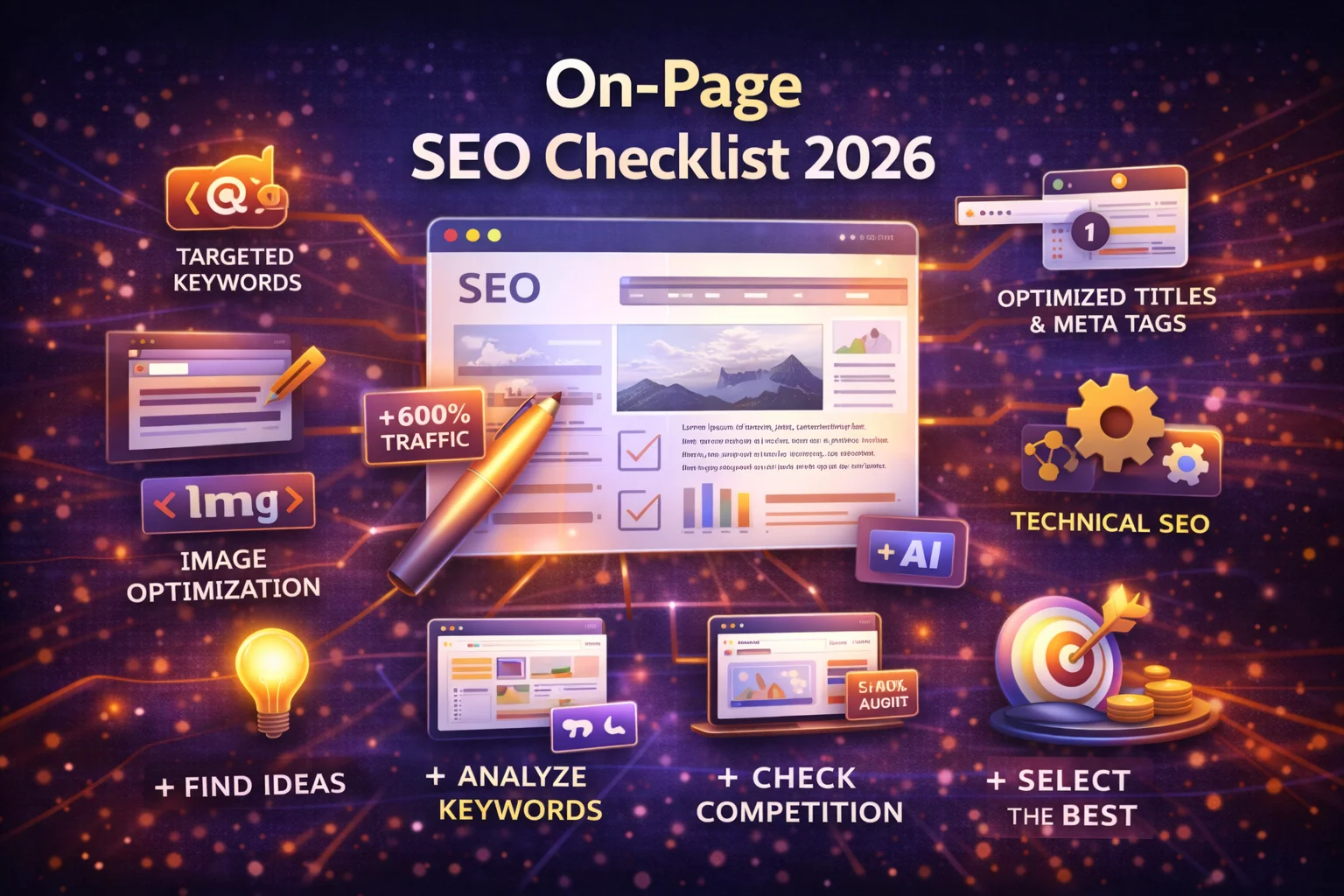
On-page SEO is one of the most important aspects of search engine optimization. While backlinks and technical factors also influence rankings, optimizing the content and structure of individual pages is often the first step toward improving search visibility.
In simple terms, on-page SEO refers to the practice of optimizing elements within a web page to improve its ranking in search engine results and provide a better user experience. These elements include content quality, keyword placement, headings, internal links, page speed, and more.
For beginners, understanding and implementing on-page SEO can dramatically increase the chances of ranking higher on search engines like Google. This guide provides a complete on-page SEO checklist for 2026, covering the most important factors that help websites rank in modern search results.
What Is On-Page SEO?
On-page SEO involves optimizing the content and HTML elements of a page so that search engines can understand it and rank it appropriately. Unlike off-page SEO, which focuses on backlinks and external signals, on-page SEO is entirely under your control.
Examples of on-page SEO factors include:
- keyword optimization
- title tags and meta descriptions
- internal linking
- content quality
- page structure
- mobile usability
Search engines analyze these elements to determine whether a page provides relevant and valuable information for users.
Why On-Page SEO Matters in 2026
Search engines have evolved significantly in recent years. Modern algorithms use artificial intelligence and advanced natural language processing to evaluate content quality and relevance.
Despite these advancements, on-page SEO remains essential because it helps search engines interpret your content and understand its context.
Key benefits of on-page SEO
- Improves search engine rankings
- Helps search engines understand page content
- Enhances user experience
- Increases organic traffic
- Improves click-through rates
When implemented correctly, on-page optimization ensures that your website communicates clearly with both users and search engines.
The Complete On-Page SEO Checklist
Below is a step-by-step checklist beginners can follow to optimize their pages effectively.
1. Perform Keyword Research First
Every successful SEO strategy starts with keyword research. Before creating content, you must identify the keywords people search for related to your topic.
Keyword research helps you discover:
- search demand
- keyword difficulty
- user intent
Focus on keywords that have:
- moderate search volume
- lower competition
- clear search intent
Long-tail keywords are particularly valuable for beginners because they are easier to rank for.
Example:
Instead of targeting:
SEO tools
Target:
best SEO tools for beginners
2. Optimize the Title Tag
The title tag is one of the most important on-page SEO elements.
It tells search engines and users what your page is about and appears as the clickable headline in search results.
Best practices for title tags
- include your primary keyword
- keep it under 60 characters
- make it engaging for users
Example:
Complete On-Page SEO Checklist for Beginners (2026 Guide)
A well-optimized title tag can significantly improve click-through rates.
3. Write a Compelling Meta Description
Meta descriptions summarize your page content and appear below the title in search results.
Although meta descriptions are not a direct ranking factor, they strongly influence click-through rates.
Best practices
- keep length around 150–160 characters
- include your main keyword
- highlight the value of the content
Example:
“Learn the complete on-page SEO checklist for beginners in 2026. Optimize titles, content, internal links, and technical factors to rank higher in Google.”
4. Use Proper Heading Structure
Headings organize your content and make it easier for both readers and search engines to understand.
Use headings in a logical hierarchy.
Example:
- H1 – main title
- H2 – main sections
- H3 – subtopics
A clear structure improves readability and helps search engines identify important topics within your content.
5. Optimize Content for Search Intent
Search intent refers to the reason behind a user’s search query.
Search engines prioritize pages that satisfy the user’s intent.
There are four main types of search intent:
| Intent Type | Example |
|---|---|
| Informational | what is SEO |
| Navigational | YouTube login |
| Commercial | best SEO tools |
| Transactional | buy website builder |
Before writing content, analyze the top search results for your keyword to understand what users expect.
6. Write High-Quality Content
Content quality remains one of the most important ranking factors.
Your content should be:
- helpful
- accurate
- well-structured
- comprehensive
Modern search algorithms prioritize content that demonstrates expertise and provides clear value.
High-quality content also increases engagement and reduces bounce rates.
7. Use Internal Links
Internal links connect pages within your website.
They help search engines discover content and distribute authority across your site.
Example internal links:
- linking related blog posts
- linking product pages from guides
- linking tutorials from category pages
Internal linking also improves user navigation and encourages visitors to explore more content.
8. Optimize Images
Images play an important role in both user experience and SEO.
However, large images can slow down page speed.
Image optimization tips
- compress images to reduce file size
- use descriptive file names
- add alt text
Alt text helps search engines understand what the image represents and improves accessibility.
9. Improve Page Loading Speed
Page speed is a ranking factor because slow websites create poor user experiences.
Users expect websites to load quickly, especially on mobile devices.
Ways to improve page speed include:
- compressing images
- using fast hosting
- minimizing scripts
- enabling caching
Faster websites generally achieve better engagement and rankings.
10. Ensure Mobile-Friendly Design
Most internet users now access websites on mobile devices.
Search engines prioritize mobile-friendly websites in search results.
Your pages should:
- adapt to smaller screens
- use readable fonts
- provide easy navigation
Responsive design ensures your content looks good on all devices.
11. Use SEO-Friendly URLs
URLs should be simple, descriptive, and include relevant keywords.
Example:
Bad URL:
example.com/page?id=123
Good URL:
example.com/on-page-seo-checklist
Clean URLs improve readability and help search engines understand page topics.
12. Add Schema Markup
Schema markup helps search engines understand the structure of your content.
It can also improve visibility in search results by enabling rich snippets.
Examples include:
- FAQ schema
- article schema
- product schema
Structured data enhances how your pages appear in search results.
13. Optimize for Featured Snippets
Featured snippets appear at the top of search results and provide quick answers to user queries.
To increase your chances of appearing in snippets:
- answer questions clearly
- use lists and tables
- provide concise explanations
Content structured this way is easier for search engines to extract.
14. Monitor SEO Performance
SEO is an ongoing process.
Track your results using analytics and search console tools to understand:
- keyword rankings
- organic traffic
- click-through rates
Regular monitoring helps identify opportunities for improvement.
Common On-Page SEO Mistakes
Many beginners make mistakes that limit their SEO performance.
Keyword stuffing
Using keywords excessively can harm readability and rankings.
Ignoring search intent
Content must align with user expectations.
Poor internal linking
Internal links help distribute authority and improve navigation.
Low-quality content
Thin or poorly written content rarely ranks well.
Avoiding these mistakes is essential for long-term SEO success.
On-Page SEO Trends in 2026
SEO continues evolving as search engines become more sophisticated.
Several trends are shaping modern on-page optimization.
AI-powered search
Search engines use AI to interpret content and understand context more accurately.
Topical authority
Websites that cover topics deeply across multiple pages perform better in search results.
E-E-A-T signals
Google evaluates content based on experience, expertise, authoritativeness, and trustworthiness.
User experience signals
Engagement metrics such as time on page and bounce rate influence rankings.
Final Thoughts
On-page SEO is the foundation of any successful SEO strategy. By optimizing your content, page structure, and technical elements, you help search engines understand your website and improve your chances of ranking higher in search results.
For beginners, the most important steps include conducting keyword research, writing high-quality content, optimizing titles and headings, improving page speed, and ensuring mobile usability.
As search engines continue evolving in 2026, focusing on user intent, content quality, and technical optimization will remain essential for long-term SEO success.
By following this on-page SEO checklist consistently, you can build a strong foundation that helps your website grow its visibility and attract sustainable organic traffic.
FAQ’s
1. What is on-page SEO?
On-page SEO refers to optimizing elements within a web page—such as content, title tags, headings, internal links, and images—to improve its ranking in search engine results.
2. Why is on-page SEO important for ranking on Google?
On-page SEO helps search engines understand your content and determine its relevance to user queries. Proper optimization improves visibility, increases organic traffic, and enhances user experience.
3. What are the most important on-page SEO factors?
Key on-page SEO factors include keyword optimization, high-quality content, title tags, meta descriptions, internal linking, mobile-friendliness, page speed, and proper heading structure.
4. How do beginners optimize a page for SEO?
Beginners can optimize pages by performing keyword research, writing helpful content, using clear headings, optimizing titles and meta descriptions, adding internal links, and ensuring fast page loading speed.
5. Does on-page SEO still matter in 2026?
Yes, on-page SEO remains one of the most important ranking factors in 2026 because it helps search engines understand content relevance, improves user experience, and supports topical authority.